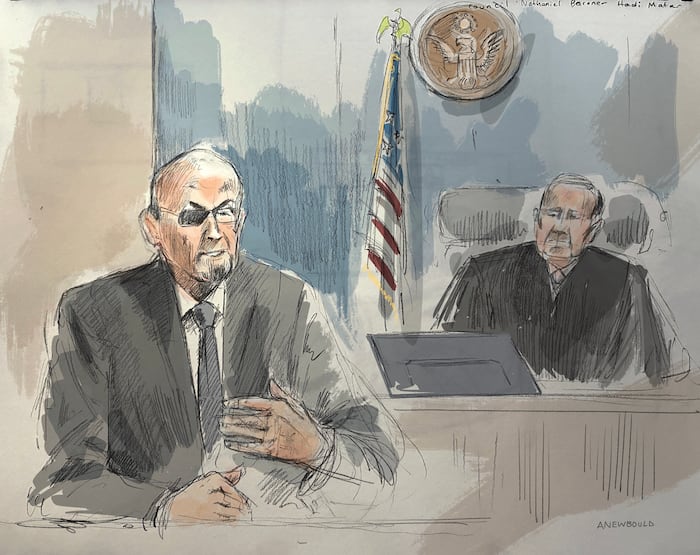
Renowned author Salman Rushdie faced his convicted attacker in a Buffalo federal courtroom on July 23, 2026, delivering powerful testimony about the violent ambush that nearly claimed his life four years ago. The 79-year-old prize-winning writer recounted the harrowing moments of the 2022 attack with remarkable composure, describing in vivid detail how a knife came within a millimeter of his brain.
A Survivor’s Account of the Brutal Attack
During more than an hour on the witness stand, Rushdie methodically outlined the assault that occurred while he prepared to speak at the Chautauqua Institution in New York. The author recalled initially believing he had been punched under his chin before realizing blood was streaming from his neck.
“I was on the stage, lying down, with an enormous pool of blood all around me. It was an enormous and expansive lake of blood.”
The defendant, 28-year-old Hadi Matar, sat at the defense table throughout Rushdie’s testimony, mostly looking down and occasionally resting his hand on his chin. He only turned to look at the author as Rushdie exited the courtroom, while the writer appeared to barely acknowledge his attacker’s presence.
Devastating Injuries and a Long Road to Recovery
Rushdie provided jurors with a comprehensive account of the injuries he sustained during the attack, which saw Matar climb onto the stage, approach from behind, and slash the author 15 times while horrified audience members watched. The assault left the celebrated writer with life-altering wounds:
- Complete blindness in his right eye, which Rushdie demonstrated by removing his glasses in court
- Severe liver damage requiring extensive medical intervention
- Temporary paralysis in his left hand
- A period on a ventilator as doctors fought to save his life
The attack unfolded at a cultural institution where Rushdie had been scheduled to discuss threats facing writers and artists around the world. Spectators and fellow speaker Henry Reese rushed to help the wounded author and restrain Matar, who was subsequently arrested by law enforcement officers assigned to the event.
The Shadow of a Decades-Old Death Sentence
Federal prosecutors argue that Matar’s assault was motivated by Iran’s 1989 fatwa calling for Rushdie’s death. The late Ayatollah Ruhollah Khomeini issued the religious edict in response to Rushdie’s novel “The Satanic Verses,” which contains a dream sequence about Islam’s Prophet Muhammad that some Muslims deemed blasphemous.
The book sparked violent protests worldwide and forced Rushdie, who was born into a Muslim family, into hiding for years. Although the Iranian government distanced itself from the order in 1998, the fatwa was never officially repealed.
Rushdie testified that for more than two decades following the easing of tensions, he led a public life without incident. However, when defense attorney Nathaniel Barone asked whether Rushdie believed the defendant had connections to terrorism, the author responded that while he had no direct knowledge, he harbored suspicions.
Defense Strategy and Potential Testimony
Matar has pleaded not guilty to federal terrorism charges, though he was previously convicted on state-level attempted murder charges and is currently serving a 25-year prison sentence. The defense team has centered their strategy on arguing that prosecutors cannot definitively prove Matar’s intent or state of mind at the time of the attack.
This proof of motivation is crucial to the prosecution’s claim that the stabbing constituted an act of terrorism driven by allegiance to Iran’s government and the Iranian-backed Hezbollah militant group. If convicted on federal charges, including engaging in an act of transnational terrorism, Matar faces a potential life sentence.
Prosecutors have indicated that Matar was partly inspired by comments from the late Hassan Nasrallah, a former Hezbollah leader. Defense attorney Barone has suggested that his client may take the stand in his own defense, potentially providing his own account of the events that shocked the literary world.
When Barone repeatedly questioned whether Rushdie had anticipated negative reactions to his controversial novel, the author offered a pointed response: “Probably, but I don’t believe the book to be on trial here. I believe someone else is on trial.” The judge subsequently ordered this comment struck from the official court record at the defense’s request.