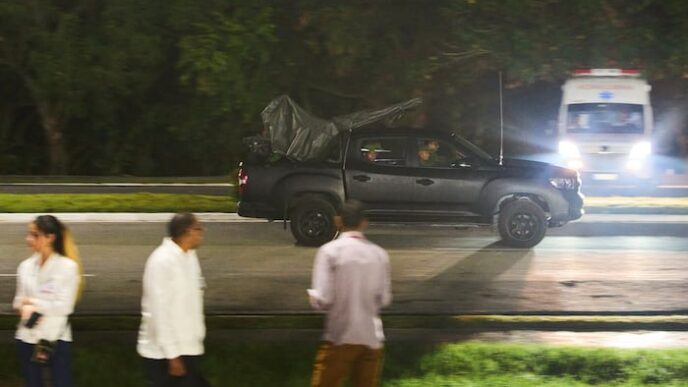
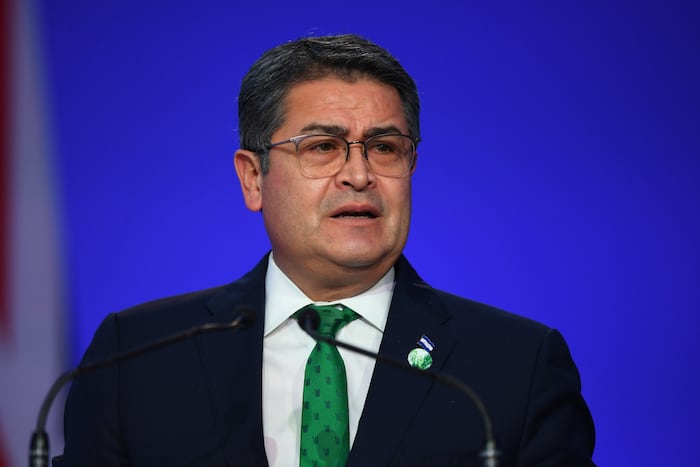
In a dramatic turn of events that has captured the attention of Latin communities across the Americas, including Miami’s vibrant Honduran population, former Honduran President Juan Orlando Hernández has returned to his homeland on July 26, 2026. The controversial leader, who was once serving a 45-year sentence in the United States for drug trafficking, now faces corruption charges in a country where many doubt justice will prevail.
A Controversial Homecoming After Presidential Pardon
Four years after his extradition to the United States, where he faced trial for drug trafficking crimes, Hernández touched down in Honduras following a presidential pardon from Donald Trump in December 2025. The pardon shocked observers in both the United States and Honduras, with Trump claiming the former Honduran president did not receive a fair trial and that the case was orchestrated by the Biden administration.
The former leader, who governed Honduras from 2014 to 2022, was once considered a key U.S. ally in the war against drugs. However, U.S. prosecutors painted a very different picture during his trial, alleging he boasted about wanting to “shove the drugs right up the noses of the gringos.” His return to Honduras represents a significant moment for the country’s political landscape and raises serious questions about accountability and justice in the region.
“There is a social majority that is outraged, but doesn’t speak out because of fear. We’re talking about the boss of all drug bosses,” said Joaquín Mejía, lawyer and researcher for the human rights organization Reflection, Research and Communication Team.
Corruption Charges and the Pandora I Case
The former Honduran president now faces charges related to a case known as Pandora I, which alleges widespread corruption during his time in power. According to investigations by Honduras’s Specialized Prosecutor’s Unit Against Corruption Networks (UFERCO), the case involves serious allegations of financial misconduct:
- A network of former high-ranking officials allegedly participated in illegal disbursements from 2010 to 2013
- Public funds totaling more than 288 million lempiras (approximately $10.8 million) were allegedly funneled to various foundations
- Hernández allegedly received at least 62 million lempiras ($2.3 million) for his political campaign
- The scheme allegedly involved shell companies, straw men, and fictitious contracts
The former president has maintained his innocence, stating that the case “lacks any legal basis.” In June 2026, a judge suspended his arrest warrant and the international red notice issued to Interpol at his lawyer’s request, though the case remains pending. Hernández has agreed to appear before the judge on August 3 for his arraignment.
What This Means for Miami’s Honduran Community
For the significant Honduran diaspora in South Florida, the return of the former Honduran president carries deep emotional weight. Many Hondurans fled their homeland during Hernández’s tenure, seeking safety and opportunity in Miami and surrounding areas. The developments in this case are being closely watched by families who have personal connections to the political turmoil that defined his presidency.
The situation also highlights the complex relationship between U.S. foreign policy and Latin American nations, a dynamic that directly affects immigrant communities in Miami. As the former president navigates the Honduran justice system, many in South Florida are skeptical that true accountability will be achieved.
Concerns About Justice System Integrity
Legal experts and human rights advocates have expressed serious doubts about the likelihood of a fair trial. Luis Javier Santos, the former head of UFERCO who investigated the case against the former Honduran president, was removed from his position in February 2026. He believes this demonstrates attempts to suppress anti-corruption investigations under the new government of Nasry Asfura, a member of Hernández’s National Party.
“We have gone backward to an even worse point than when all the work to fight corruption began,” Santos stated, reflecting the frustration felt by many who hoped for justice.
Other high-level officials implicated in the Pandora I case have seen their charges dismissed, suggesting a troubling pattern. Mejía predicts that the suspended arrest warrant is merely “the first step” toward complete impunity, with alternative measures likely to be issued “to keep up appearances” before all sanctions disappear.
A Nation Watching and Waiting
As the former Honduran president prepares for his August arraignment, the eyes of Honduras and its diaspora remain fixed on unfolding events. The outcome of this case will send a powerful message about the state of justice and democracy in the Central American nation. For Miami’s Latin community, particularly those with roots in Honduras, this story represents more than political news—it reflects hopes, fears, and the ongoing struggle for accountability in their homeland.
The former president expressed his eagerness to reunite with his family in a social media video, stating, “The moment has arrived. After four years, I can finally tell you that we will see each other again.” His wife, Ana García, and their children have had their U.S. visas suspended, adding another layer to this complex family and political saga that continues to unfold.